Bathroom Light Zones are the first thing you need to understand, showing where you can install what type of light. Many assume you must have an IP65 light in the bathroom; this isn’t necessarily true, nor the whole picture.
Let us explain.
Current Regulations for Bathroom Lights | Edition 18
It is important when installing bathroom lights that the regulations are followed to ensure safety for all users. It is also important if you intend letting your property as you will be required to have your electrical system certified. The rules are in BS 7671 (18th Edition), and our full bathroom light zones guide on Great Lighting UK, our parent website, covers them in more detail.
Bathroom Light Zones
The main object is to ensure safety in the bathroom or wet area and in essence keeping water away from any electrical source.
So generally not using any mains powered portable light in the bathroom i.e. no table or floor lamps, (unless the bathroom is large enough, and the lead short enough, to make it impossible to put the fitting into a wet space).
Note: Please bear in mind each application is slightly different, but the dimensions given are a minimum requirement
Zones define what is required
- Zone 0 – inside the bath or shower tray itself. IPX7 minimum, and 12V SELV low voltage only.
- Zone 1 – above the bath or shower, up to 2.25m from the floor. IPX4 (IP44) minimum, or IPX5 where water jets may be used. IP65 is a popular choice directly inside a shower enclosure, but it is not required.
- Zone 2 – the 60cm beyond Zone 1. IPX4 (IP44) minimum.
- Outside the zones (often still called Zone 3) – no minimum IP rating is set, so IP20 is permitted. IP44 gives extra margin against steam in a small or poorly ventilated room.

You can also use spotlights if you require directional light or wall mounted bathroom lights for mood lighting. You can use 240V fittings in Zones 1 and 2 and outside the zones, but a light in Zone 0 (for example in a shower cubicle) must run from a 12V SELV system, with the transformer outside that zone, usually in a roof void.
With all bathroom lights, placement i.e. where in the bathroom you wish to install the light will determine the types available as the bathroom is split into zones. Lights are also rated by IP (Ingress Protection) and 2 numbers, or IPX plus a number. The higher the number, the more protected the fitting is.
IP ratings explained:
IP is short for Ingress Protection, followed by two figures. The first digit shows protection against solid objects, the second against water. (You may also see IPX and one number, which gives the water rating only.) IP20, common on household lights, means fingers and objects over 12.5mm cannot get in, and there is no water protection. IP44, a common rating for outdoor and bathroom lights, means objects over 1mm cannot get in, and the light is protected against splashing from any direction, including rain. IP65 is dust-tight and protected against low-pressure water jets. For bathrooms the second digit is the one that matters.
The larger your bath or shower room, the easier it is to place lights away from the zones, and the greater your choice of fittings. Outside the zones, which includes the centre of most bathrooms, a standard IP20 ceiling light is permitted. In a smaller bathroom, or one with poor ventilation, an IP44 light gives extra margin against steam. Directly over a bath or shower you need at least IP44. A flush or fixed fitting will suit most rooms.
Switches should be a ceiling pull cord, or sited outside the room, as wall switches are not allowed in the zones.
So what are the options?
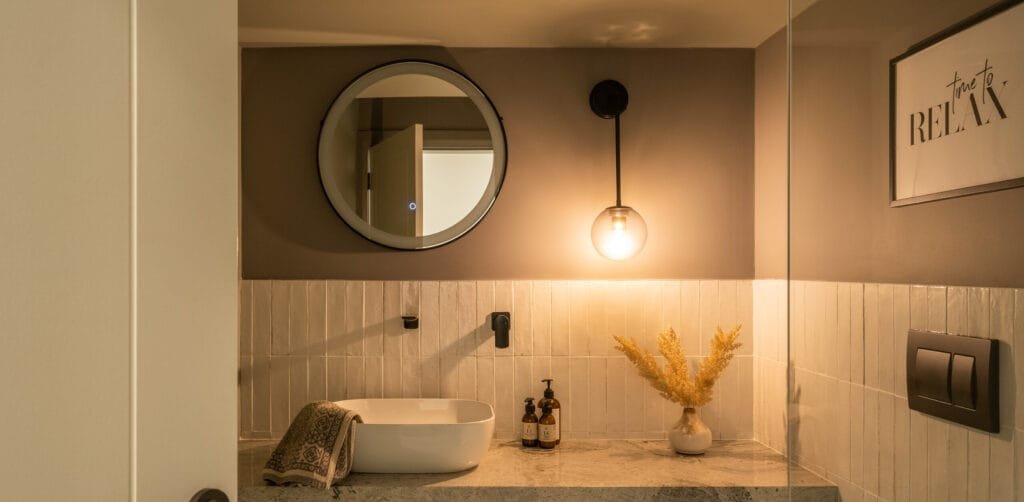
The choice is large, in glass, brass, or ceramics. Above a bath or shower, IP44 is the minimum, and IP65 is a popular choice where the light is inside the shower enclosure or likely to take spray; flush ceiling lights suit this, see IP65 Flush Ceiling Lights. For wall fittings around the bathroom, in Zone 2, IP44 brass or glass wall sconces make the room look cosy. Or if you have a reasonable size bathroom, why not use a pendant to create an impact.
Now you can choose your new Bathroom Light
If you are looking for a pendant that sits more than 60cm (horizontally) from the edge of your bath or shower, then the pendants here will work well. If space is tighter, or you want IP44 or IP65, see our bathroom light zones guide and our complete selection of bathroom lighting ideas at Great Lighting UK, our parent website.